Author = Shadi Azizi
Number of Articles: 2
The development of in-between spaces in houses during Qajar and Pahlavi I period based on changes of value

The development of in-between spaces in houses during Qajar and Pahlavi I period based on changes of value

Volume 14, Issue 2, December 2023, Pages 345-365

https://doi.org/10.30475/isau.2023.324828.1851

Paria Aliakbari, Shadi Azizi, Mozaien Dehbashi Sharif

Abstract Extended Abstract Background and Objectives: Every culture provides human patterns in various time periods which determine activities, achievements and social responsibilities of people. These cultural patterns and values influence individuals’ lifestyles and guide their actions. Consequently, the formed values of traditional societies undergo transformation as global social changes and revolutions redefine societal norms. In this process, the values with which people lived their lives for years and then formed their physical environment are replaced with some new values and patterns. Therefore, it can be said that space matters in understanding the changes and social developments that have taken place in the society in the space-time dimension. In order to see the changes that have taken place in the society, one must pay attention to its physical appearance in order to understand the root of the transformation in the structures of the society. Architecture and the city can be considered as elements that are affected by the societal conditions, effectively illustrating and manifesting societal changes. One of the most important causes of spatial changes are the social changes. According to social psychologists and sociologists, social changes influence societies in both materialistic and non-materialistic aspects. This study aims to explore non-materialistic aspects, particularly changes of value, and their materialistic effects on spaces, focusing specifically on in-between spaces.
Methods: The methodology used in this study is qualitative in nature, with an exploratory-historical and post-analytical logic. The exploratory-historical logic explores historical contexts to understand societal mechanisms and approaches. Meanwhile, the post-analytical logic examines current societal mechanisms and approaches and constructs hypothetical models to explore underlying relationships. Data collection for this study involved gathering information from various sources, including bibliographic research, as well as primary and secondary resources such as images and documents.
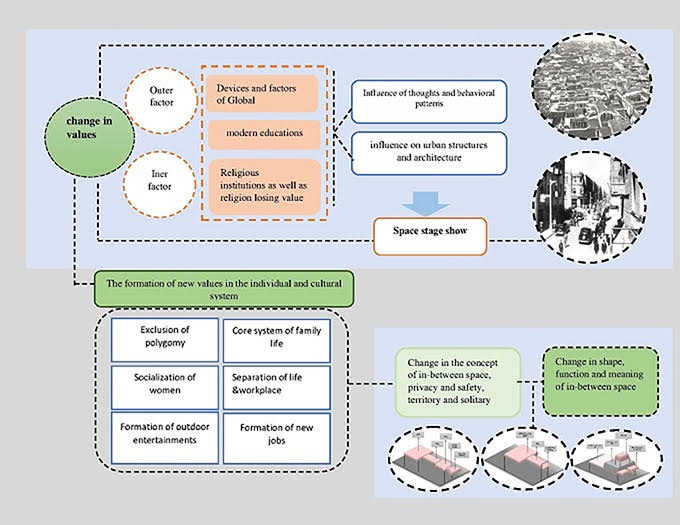
Findings: Values of a society reveal the culture and beliefs of a nation which can directly impact the form and structure of its built environment. As a result, in-between spaces, as semi-public and semi-private spaces, carry several roles which are being affected by the values of their time. These values were transformed in Qajar period when the signs of modernity appeared in architecture. The findings highlight the emergence of new societal values, including socialization of women in society, rejection of polygamy among men, shrinking families (nuclear structure), separation between home and workplace, outburst of western goods (new appliances of life, formation of new entertainment out of home, emergence of service jobs, individualism and independent lifestyles). The aforementioned factors have changed in-between spaces through some structural changes, so they formed new values and have changed the notions of in-between spaces, such as privacy, private area and personal spaces. Consequently, new forms of in-between spaces, such as balconies, pause areas, and horizontal divisions like stairways, have emerged to accommodate these evolving societal values.
Conclusion: The reciprocal relationship between space and social changes is evident in the two studied periods. During the Qajar and Pahlavi I period, the construction of new spaces and buildings that were not seen before in Iranian society, led to significant physical changes that mirrored evolving societal values. On the other hand, cultural connections with the West, educational trips, travel and printing of books and newspapers and other factors led to major changes in individual and social values. Consequently, the spaces within households, including crucial communication and intermediary areas, underwent transformations to accommodate the evolving needs of individuals, which differed noticeably from those of previous generations.

The effectiveness of gamification education on architectural students’ academic burnout and its role in the learning process of design

The effectiveness of gamification education on architectural students’ academic burnout and its role in the learning process of design

Volume 13, Issue 1, May 2022, Pages 297-309

https://doi.org/10.30475/isau.2020.239546.1464

Mozhgan Raoufrahimi, Shadi Azizi, Mehrdad Javidinejad, Amir Sadeghi

Abstract Extended Abstract
Background and Objectives: Architecture education has always been associated with two different and complementary processes: creative thinking and linear/technical thinking. Today, the process of training an architect in an academic environment is usually based on design studios, which is complemented by formal training in theoretical and technical topics. This system is based on the idea that it will enable students to develop creative and appropriate solutions. However, this teaching method might cause hidden problems that, in some cases, can hinder students’ learning progress and cause their full potential skills not to be identified and exploited. Ateliers (workshops) in architecture schools are the main teaching tools in which students are exposed to solving many design problems. Since burnout causes the learning process to decline, its reduction is of interest to many academic settings. Burnout is one of the educational system problems at all educational levels, which leads to a waste of power and expenses and can have a devastating effect on personal and academic life. In addition, new and various educational methods, including gamification, have been reviewed, improved, and used over the years. For various purposes, educational non-entertainment games (serious games) are designed to achieve academic goals and values and to develop skills.
Methods: Games are fun ways to learn and provide a safe and secure environment in a simulated environment for learners to make decisions and even make mistakes without fear of real-world consequences. The player can confront a variety of challenges in the games that conform to the latest proven principles of learning effectiveness. Learning through educational games is unconscious, indirect, and effective. This study aims to investigate the effectiveness of architecture design education at the undergraduate level in reducing students’ academic burnout and thus improving the learning process of design. This method aims to maximize students’ capacity to acquire information and skills. Their creative and technical competencies have been integrated to improve the effectiveness of architectural education and increase future architects’ work quality. This study was conducted experimentally using a pretest-posttest design with control and intervention groups. The statistical population of this study was the students of Parand Branch Azad University, who were randomly selected to participate in this research. They are equally divided into two intervention and control groups. MBI-GS (S) standard burnout questionnaire was used to collect data, and SPSS.22 software was used for statistical data analysis. The games were designed under the chapter to achieve the research objectives and performed in the intervention group’s studio.
Findings: Student feedback was recorded at each level of the games and at the end of the semester, with very interesting results in student design quality, increased motivation, and interest. Hence, the design learning promotion was achieved. Statistical results show that there is a big difference between the three conceptual sections of academic burnout, including exhaustion (feeling tired because of study requirements), cynicism (having a pessimistic and apathetic attitude towards homework), and professional efficacy (feeling incompetent as a student). There were intervention and control groups among the students after completing the training sessions and holding a post-test. Therefore, the study of academic burnout and effective strategies in reducing exhaustion to achieve educational goals and improve the design learning process was the criterion of this study, in contrast to other previous studies that examined the result of gamification in the product of architecture and design, or studied the purely psychological effects of burnout. The design learning process was examined, considering the concepts of gamification education and academic burnout. Finally, the gamification method in architectural design education was tested in line with reducing students’ academic burnout.
Conclusion: Based on the study findings, it can be concluded that gamification education in architectural design effectively reduces academic burnout, increases interest and motivation, and increases student participation in practical activities of the studio. Therefore, it is recommended to use this new educational method to reduce academic burnout and improve architectural design learning.