نوع مقاله : مقاله پژوهشی
نویسندگان
1 دانشجوی دکتری معماری، گروه معماری، دانشکده معماری و شهرسازی، واحد تهران مرکزی، دانشگاه آزاد اسلامی، تهران، ایران.
2 استادیار، گروه معماری، دانشکده معماری و شهرسازی، واحد تهران مرکزی، دانشگاه آزاد اسلامی، تهران، ایران.
چکیده تصویری
تازه های تحقیق
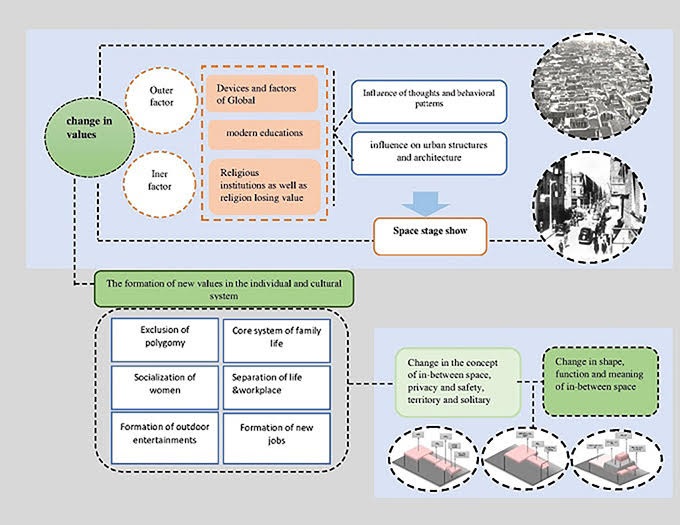
- دستاوردهای بهرهگیری از رویکرد «فضا صحنه» در تحلیلات فضای میانی، سبب میشود، به کلیه مسائل اجتماعی-فضایی و همچنین تعاملات و کنشهای انسانی توجه شود.
- نظریه جانسون، تعادل یک نظام اجتماعی را تابع درجۀ سازگاری بین ارزشهای یک جامعه و شرایط محیطی آن جامعه میداند. او منابع تغییر یک نظام اجتماعی متعادل را دو عامل تغییرارزش و محیط بیان میدارد.
- مهمترین مولفههای تغییردر ارزشها در جوامع طبق نظریه جانسون را میتوان، به نقش انقلابها در جوامع همسایه، کمرنگ شدن مذهب، آموزشهای جدید و اکتشافات و ابداعات جدید و دیگر موارد مطرح میباشند، که در دگرگونی ارزشهای فرهنگی و فردی افراد در عصر قاجار و پهلوی اول بسیار تاثیرگذار بودهاند.
کلیدواژهها
عنوان مقاله English
نویسندگان English
Extended Abstract
Background and Objectives: Every culture provides human patterns in various time periods which determine activities, achievements and social responsibilities of people. These cultural patterns and values influence individuals’ lifestyles and guide their actions. Consequently, the formed values of traditional societies undergo transformation as global social changes and revolutions redefine societal norms. In this process, the values with which people lived their lives for years and then formed their physical environment are replaced with some new values and patterns. Therefore, it can be said that space matters in understanding the changes and social developments that have taken place in the society in the space-time dimension. In order to see the changes that have taken place in the society, one must pay attention to its physical appearance in order to understand the root of the transformation in the structures of the society. Architecture and the city can be considered as elements that are affected by the societal conditions, effectively illustrating and manifesting societal changes. One of the most important causes of spatial changes are the social changes. According to social psychologists and sociologists, social changes influence societies in both materialistic and non-materialistic aspects. This study aims to explore non-materialistic aspects, particularly changes of value, and their materialistic effects on spaces, focusing specifically on in-between spaces.
Methods: The methodology used in this study is qualitative in nature, with an exploratory-historical and post-analytical logic. The exploratory-historical logic explores historical contexts to understand societal mechanisms and approaches. Meanwhile, the post-analytical logic examines current societal mechanisms and approaches and constructs hypothetical models to explore underlying relationships. Data collection for this study involved gathering information from various sources, including bibliographic research, as well as primary and secondary resources such as images and documents.
Findings: Values of a society reveal the culture and beliefs of a nation which can directly impact the form and structure of its built environment. As a result, in-between spaces, as semi-public and semi-private spaces, carry several roles which are being affected by the values of their time. These values were transformed in Qajar period when the signs of modernity appeared in architecture. The findings highlight the emergence of new societal values, including socialization of women in society, rejection of polygamy among men, shrinking families (nuclear structure), separation between home and workplace, outburst of western goods (new appliances of life, formation of new entertainment out of home, emergence of service jobs, individualism and independent lifestyles). The aforementioned factors have changed in-between spaces through some structural changes, so they formed new values and have changed the notions of in-between spaces, such as privacy, private area and personal spaces. Consequently, new forms of in-between spaces, such as balconies, pause areas, and horizontal divisions like stairways, have emerged to accommodate these evolving societal values.
Conclusion: The reciprocal relationship between space and social changes is evident in the two studied periods. During the Qajar and Pahlavi I period, the construction of new spaces and buildings that were not seen before in Iranian society, led to significant physical changes that mirrored evolving societal values. On the other hand, cultural connections with the West, educational trips, travel and printing of books and newspapers and other factors led to major changes in individual and social values. Consequently, the spaces within households, including crucial communication and intermediary areas, underwent transformations to accommodate the evolving needs of individuals, which differed noticeably from those of previous generations.
کلیدواژهها English
این مقاله برگرفته از رساله دکتری نویسنده نخست با عنوان «تحلیل و بررسی روند تحول فضاهای میانی در مسکن از قاجار تا پهلوی از منظر تعامل اجتماعی در فضا» میباشد که به راهنمایی نویسنده دوم و مشاوره نویسنده سوم در دانشگاه آزاد اسلامی واحد تهران مرکزی انجام گرفته است.
This article is derived from the first author`s doctoral thesis entitled “Analysis and Investigation of the Evolution Process of In-Between Spaces in Housing from Qajar to Pahlavi Era in Terms of Social Interaction in the Space”, supervised by the second author and advised by the third, at Islamic Azad University, Tehran Central Branch.