تحلیلی بر ارتقای مقبولیت عمومی معماری خاک در شهر یزد

نوع مقاله : مقاله پژوهشی

نویسندگان

1 دانشجوی دکتری معماری، گروه معماری، واحد پروفسور حسابی، دانشگاه آزاد اسلامی، تفرش، ایران.

2 استادیار، گروه معماری، واحد قم، دانشگاه آزاد اسلامی، قم، ایران.

3 استادیار، گروه معماری، واحد یادگار امام خمینی (ره) شهرری، دانشگاه آزاد اسلامی، تهران، ایران.

4 استادیار، گروه معماری، واحد تهران مرکزی، دانشگاه آزاد اسلامی، تهران، ایران.

چکیده
معماری خاک، یکی از فنون ساخت در معماری با غنای تاریخی چندهزارساله است که ردپای آن در معماری ملل مختلف جهان ازجمله کشور ایران نمایان است. علی‌رغم پیشینه و ظرفیت‌های غنی موجود؛ روند استفاده فراگیر و مقبولیت معماری خاک در دوره معاصر بنا بر رشد فناوری در مصالح رقیب صنعتی و تغییرات فرهنگی ساخت‌وساز با افول محسوسی همراه بوده است. هدف از این پژوهش، شناخت تنگناها و راه‌های ارتقای معماری خاک با تأکید بر بستر شهر تاریخی یزد است. روش این پژوهش، کیفی و مبتنی بر مطالعات کتابخانه‌ای و همراه با استدلال قیاسی همراه با ماهیت دوگانه نظری - کاربردی است. ابزارهای جمع‌آوری داده‌های پژوهش؛ تحلیل محتوای ادبیات نظری تحقیق و یک پرسش‌نامه خبره محور با رجوع به ده کارشناس خبره معماری و شهرسازی شهر یزد است. یافته‌های پژوهش نشان می‌دهد معماری خاک علی‌رغم برخورداری از مجموعه‌ای از مزایا و معایب همانند دیگر فنون و سبک‌ها در معماری؛ دارای مجموعه‌ای از چالش‌ها، موانع و پیش‌ران‌هایی است. گروه‌بندی و اولویت‌بندی چالش‌ها، موانع و پیش‌ران‌های معماری خاک در بخش ادبیات تحقیق و خبرگان شهر یزد نشان‌دهنده شباهت‌ها و تفاوت‌هایی است که نشانگر «مکان‌مند» بودن دامنه مقبولیت عمومی معماری خاک است. براین‌اساس، «پذیرش اجتماعی معماری خاک»؛ «برنامه‌ها و دوره‌های کم دانشگاهی» و دو مقوله «نوآوری و فناوری» و «تدوین استاندارد و معیارهای کنترلی» به ترتیب چالش‌ها، موانع و پیش‌ران‌های اولویت مند شهر یزد می‌باشند. این اولویت‌بندی می‌تواند در بسترهای معین کالبدی به‌صورت تجمیعی به‌منظور اعمال سیاست‌گذاری معمارانه مورد شناسایی و کاربرد واقع شود. همچنین، این سیاست‌گذاری جدید زمینه‌ساز توجه عام بیشتر به مقوله «مقبولیت عمومی» بوده و می‌تواند به‌صورت عملی و خاص نیز در ارتقای مقبولیت عمومی معماری خاک در شهر یزد تأثیرگذار باشد.

چکیده تصویری

تحلیلی بر ارتقای مقبولیت عمومی معماری خاک در شهر یزد

تازه های تحقیق

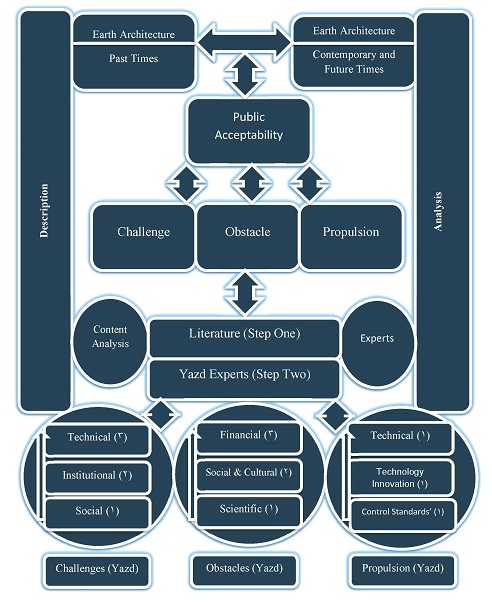
- درک عمیق از مفهوم پذیرش عمومی استفاده از معماری خاک و مصالح خاک مبنا بر اساس داده‌های موجود در ادبیات تحقیق و شناسایی علمی مختصات چالش‌ها، موانع و پیشران‌های آن.
- شناسایی سیاست‌های پیشرو برای ارتقای پذیرش عمومی استفاده از معماری خاک و مصالح خاک مبنا در شهر یزد بر اساس داده‌های اولویت‌بندی‌شده خبرگان شهرسازی و معماری شهر یزد.

کلیدواژه‌ها

موضوعات


عنوان مقاله English

An analysis on promoting the public acceptability of earth architecture in Yazd city

نویسندگان English

Amirreza Sadeghian 1
Roxana Abdollahi 2
Ali Akbari 3
,Mehrdad Javidinejad 4
1 Ph.D. Candidate in Architecture, Department of Architecture, Professor Hesabi Branch, Islamic Azad University, Tafresh, Iran.
2 Assistant Professor, Department of Architecture, Qom Branch, Islamic Azad University, Qom, Iran
3 Assistant Professor, Department of Architecture, Yadegar-e-Imam Khomeini (RAH) Shahre Rey Branch, Islamic Azad University, Tehran, Iran.
4 Assistant Professor, Department of Architecture, Central Tehran Branch, Islamic Azad University, Tehran, Iran
چکیده English

Extended Abstract
Background and Objectives: “Earth architecture” is one of the construction techniques in architecture with a rich history dating back to several thousand years, whose traces are visible in the architecture of different nations of the world, including Iran. Earth architecture is one of the sub-branches of vernacular architecture, which has a rich set of originalities and native-historical capacities in different parts of the world. Due to the extensive availability of soil; it has played a significant role in time and history by reflecting many originalities of vernacular and traditional architecture. Regions like the historical city of Yazd, characterized by desert climates, have historically been ideal environments for the development of earth architecture. Despite its longstanding heritage, contemporary attention to the various capacities and innovations of earth architecture has been lacking, with challenges and sensitivities in the field now garnering increased attention. Based on this, despite the background and existing rich capacities; The trend of widespread use and acceptability of Earth architecture in the contemporary period has been accompanied by a noticeable decline because of the growth of technology in competing industrial materials and cultural changes in construction. Public acceptability is a comprehensive and relevant matter and its application can provide the level of public acceptability. As such, the aim of this research is to identify bottlenecks and strategies to enhance the public acceptability of earth architecture in Yazd. By utilizing the public acceptability index and emphasizing the historical context of the city, the study seeks to promote the revitalization and improvement of earth architecture in the region.
Methods: The historical city of Yazd, with its desert climate, has historically provided an ideal environment for the development of earth architecture. Despite its rich heritage, contemporary attention to the diverse capacities and innovations of earth architecture has been lacking, leading to increased scrutiny of the challenges and sensitivities within the field.
Findings: The research findings reveal that Earth architecture, like other architectural techniques and styles, possesses its own set of advantages, disadvantages, challenges, obstacles, and drivers. Through content analysis of research literature and consultations with local experts, these factors have been identified and categorized. In addition, categorization and prioritization of the challenges, obstacles and drivers of earth architecture in the research literature and experts of Yazd shows the similarities and differences that indicate the “locality” of the public acceptability of earth architecture. From a comparative point of view, regarding the challenges in the scale of world literature, “technical challenges” have been the most important issue. In the same scale and in the obstacles section, “policy-based obstacles” had more points, and in the driver’s section, “technical and architectural drivers” were emphasized more. On the other hand, public acceptance of earth architecture”; “less university programs and courses” and two categories including “innovation and technology” and “standard development and control criteria” are respectively “priority challenges”, “priority obstacles” and “priority drivers” of Yazd city.
Conclusion: The category of public acceptability of earth architecture has a set of interconnected elements that bring together different issues such as advantages and limitations, and the triple bottlenecks of challenges, obstacles, and drivers. Accordingly, recognizing and prioritizing the covering variables for each of these multiple elements in order to improve and promote the public acceptability of this construction method and to promote the public acceptability of earth-based materials is very important in this field. This prioritization serves as a valuable tool for identifying collective actions within specific physical contexts, facilitating the implementation of architectural policies. Moreover, this new policy framework places greater emphasis on public acceptance, thereby fostering increased attention and support for earth architecture in Yazd city. Such a focused approach can effectively promote public acceptance in a practical and targeted manner.

کلیدواژه‌ها English

Earth Architecture
Content Analysis
Architectural Policy
Yazd

این مقاله برگرفته از رساله دکتری نویسنده نخست با عنوان «تدوین مدل تحقق‌پذیری و فرهنگ‌سازی مقبول فضاهای معماری خاک پناه در شهر یزد» می‌باشد که به راهنمایی نویسنده دوم و سوم و مشاوره نویسنده چهارم در دانشگاه آزاد اسلامی واحد پروفسور حسابی انجام گرفته است.

This article is derived from the first author`s doctoral thesis entitled “Developing a model of realization and acceptable culturalization of Khak Panah architectural spaces in Yazd city”, supervised by the second  and third authors and advised by the fourth, at Islamic Azad University, Professor Hessabi Branch.
  1. Acheampong, A., Hackman, J., Ayarkwa, J., & Agyekum, K. (2014). Factors inhibiting the use of indigenous building materials (IBM) in the Ghanaian construction industry. ADRRI Journal (Multidisciplinary), 8(8).
  2. Adetooto, J., & Windapo, A. (2022). Concomitant impediments to the social acceptance of sandbag technology for sustainable and affordable housing delivery: the case of South Africa. Buildings, 12(6), 859.
  3. American Information Design Institute (2011). Architecture in a glance, notes about architecture, (H. Mozafari Tarshizi, Trans.), Tehran: Azadeh Publications, 1st ed.
  4. Asgari, Mohsen & Rahimi, Mahmoud (2017). Social adoption pf using bicycles in metropolises (Case study: Tehran metropolis), Applied Sociology, 28(1):185-206
  5. Asgari, Mohsen (2011). Theoretical investigation of social adoption with the help of behavior analysis theories, the first international conference on urban bicycle, Tehran
  6. Ben-Alon, L., Loftness, V., Harries, K. A., & Hameen, E. C. (2019). Integrating earthen building materials and methods into mainstream construction using environmental performance assessment and building policy. In IOP conference series: earth and environmental science (Vol. 323, No. 1, p. 012139). IOP Publishing.
  7. Bosman, G., & Pittaway, D. New Perspectives Towards Social Acceptability Of Earth-Constructed Buildings. International Journal of Architecture and Urban Studies, 4 (2), 77-84.
  8. Carlos, G., Ribeiro, T., Achenza, M., de Oliveira, C. C. F., & Varum, H. (2022). Literature review on earthen vernacular heritage: contributions to a referential framework. Built Heritage6(1), 1-12.
  9. Cataldo-Born, M., Araya-Letelier, G., & Pabón, C. (2016). Obstacles and motivations for earthbag social housing in Chile: energy, environment, economic and codes implications. Revista de la Construcción. Journal of Construction, 15(3), 17-26.
  10. Chandel, S. S., Sharma, V., & Marwah, B. M. (2016). Review of energy efficient features in vernacular architecture for improving indoor thermal comfort conditions. Renewable and Sustainable Energy Reviews, 65, 459-477.
  11. Creswell, J. W. (2014). Research Design Qualitative, Quantitative, and Mixed Methods Approaches (4th Ed), Thousand Oaks, CA: SAGE Publications.
  12. Dosumu, O. S., & Aigbavboa, C. (2020). An investigation of the barriers to the uptake of local materials in Africa: A literature review approach. African Journal of Science, Technology, Innovation and Development, 12 (4), 365-371.
  13. Dutier, Jean, (2013). Soil architecture with a millennia traditional future (M. Ahmadi-Nejad, Trans.), Isfahan, Khak Journal, 2nd ed.
  14. Eslami, Seyed Gholamreza, & Kamel-Nia, Hamed (2014). Collective architecture from theory to practice, Tehran: University of Tehran Press, 2nd ed.
  15. Fabbri, A., Morel, J. C., Aubert, J. E., Bui, Q. B., Gallipoli, D., Ventura, A., ... & Abhilash, H. N. (2021). An overview of the remaining challenges of the RILEM TC 274-TCE, testing and characterisation of earth-based building materials and elements. RILEM Technical Letters, 6, 150-157.
  16. Fathi, Hasan (2003). Construction with people, (A. Ashrafi, Trans.), Tehran: University of Honar Press, 2nd ed.
  17. Foruzanmehr, A. (2013). Residents’ perception of earthen dwellings in Iran. International Journal of Urban Sustainable Development.
  18. Gallipoli, D., Bruno, A. W., Perlot, C., & Mendes, J. (2017). A geotechnical perspective of raw earth building. Acta Geotechnica, 12(3), 463-478.
  19. Ghobadian, Vahid (2021). Climatic analysis of sustainable traditional buildings in Iran, Tehran: University of Tehran Press, 11th ed.
  20. Hadjri, K., Osmani, M., Baiche, B., & Chifunda, C. (2007, September). Attitudes towards earth building for Zambian housing provision. In Proceedings of the Institution of Civil Engineers-Engineering Sustainability (Vol. 160, No. 3, pp. 141-149). Thomas Telford Ltd.
  21. Hughes, E., Valdes-Vasquez, R., & Elliott, J. W. (2017). Perceptions of compressed earth block among residential contractors in North Carolina: An exploratory evaluation. Journal of Green Building, 12(4), 89-107.
  22. Hurol, Y., Yüceer, H., & Şahali, Ö. (2015). Building code challenging the ethics behind adobe architecture in North Cyprus. Science and engineering ethics, 21 (2), 381-399.
  23. Johnson, A., Windapo, A., & Pomponi, F. (2022).Barrier to the use of Sandbag Material Technologies as a Sustainable Affordable Housing Solution: Perspectives from South Africa, . EPiC Series in Built Environment, 3, 722-730.
  24. Khalili, Nader (2020). Running alone, Teran, Cheshmeh Press, 9th ed.
  25. Krippendorff, K. (2018). Content analysis: An introduction to its methodology. Sage publications.
  26. Lakys, R. E., Saad, A., Ahmed, T., & Yassin, M. H. (2022). Investigating the drivers and acceptance of sustainable materials in Kuwait: A case study of CEB. Case Studies in Construction Materials, ۱۷, e01330.
  27. Leary, M.R. (2010). Affiliation, acceptance, and belonging. In S.T. Fiske, D.T. Gilbert & G. Lindzey (Eds.), Handbook of Social Psychology (5th Ed., Vol. ۲, pp. 864–897). New York, NY: Wiley.
  28. Marsh, A. T., & Kulshreshtha, Y. (2022). The state of earthen housing worldwide: how development affects attitudes and adoption. Building Research & Information, 50 (5), 485-501.
  29. Meir, I.A; Roaf, S.C (2006). The future of the vernacular: towards new methodologies for the understanding and optimization of the performance of vernacular buildings In Vernacular Architecture in the Twenty-First Century, Theory, education and practice, Lindsay Asquith and Marcel Vellinga (EDS), Oxon: Taylor & Francis, PP: 215-230.
  30. Memarian, Gholamhossein (2018). An introduction to theoretical basics of architecture, Goljam Publication, 11th ed.
  31. Minke, Grenotu (2016). Soil architecture; design and technology of building construction based on sustainable architecture, (Sh. Ramezani, Trans.), Tehran: Part Publications, 1st ed.
  32. Molandeh, Jacque (2013). Praising soil in soil architecture with the millennial traditional future, (M. Ahmadi-Nejad, Trans., Isfahan, Soil journal, 2nd ed.
  33. Morel, J. C., & Charef, R. (2019). What are the barriers affecting the use of earth as a modern construction material in the context of circular economy? In IOP conference series: earth and environmental science (Vol. 225, No. 1, p. 012053). IOP Publishing.
  34. Morel, J. C., Charef, R., Hamard, E., Fabbri, A., Beckett, C., & Bui, Q. B. (2021). Earth as construction material in the circular economy context: practitioner perspectives on barriers to overcome. Philosophical Transactions of the Royal Society B, 376 (1834), 20200182.
  35. Moriset, S., Rakotomamonjy, B., & Gandreau, D. (2021). Can earthen architectural heritage save us?. Built Heritage, 5(1), 1-11.
  36. Niroumand, H.; Zain, M.F.M.; Jamil, M.; Niroumand, S. (2013). Earth Architecture from Ancient until Today, 2nd Cyprus International Conference on Educational Research, Procedia - Social and Behavioral Sciences 89, 222 – 225.
  37. Oliver, P. (2006). Built to meet needs: Cultural issues in vernacular architecture. Routledge.
  38. Omidvari, Somayeh (2021). Analyzing retrofitting of clay-based buildings using enhancing elements: in accordance with clay standards and regulations in New Zealand, Morocco, Peru and U.S. Bi-Quarterly of Hot and Arid Climate Architecture 9(14):241-260
  39. Onyegiri, I., & Ugochukwu, I. B. (2016). Traditional building materials as a sustainable resource and material for low cost housing in Nigeria: Advantages, challenges and the way forward. International Journal of Research in Chemical, Metallurgical and Civil Engineering, 3 (2), 247-252.
  40. Pelé-Peltier, A., Charef, R., & Morel, J. C. (2022). Factors affecting the use of earth material in mainstream construction: a critical review. Building Research & Information, 1-19.
  41. Pishavaei, Hamid-Reza & Ghayyoumi-Bidhendi, Mehrdad (2013). Soil and wisdom; a reflection about architecture in Masnavi-Manavi, Bi-Quarterly of Iran’s Architectural Studies 2(3):17-36
  42. Reddy, B. V. V., Mani, M., & Walker, P. (2019). Earthen dwellings and structures: current status in their Adoption. In Springer Transactions in Civil and Environmental Engineering. Preface, p. VII, Introduction, p. xxv. Singapore: Springer Nature Singapore Pte Ltd. ISBN 978-981-13-5882-1 ISBN 978-981-13-5883-8 (eBook). doi:10.1007/978- 981-13-5883-8.
  43. Saba, L. A., Ahmad, M. H., Binti, R., & Majid, A. (2017). Barriers and Aspirations for Sustainable Local Building Materials Selection in Nigeria.
  44. Sadeghian, Amir-Reza, (2018). Housing with clay structures, Tehran: Arshadan, 1st ed.
  45. Salizzoni, E. (2021). Challenges for Landscape Architecture: Designed Urban Ecosystems and Social Acceptance. Sustainability, 13(7), 3914.
  46. Sayigh, A. (2019). “Conclusions”, In “Sustainable vernacular architecture: how the past can enrich the future” (Eds). Springer.
  47. Schade, J. & Schlag, B. (2000). Acceptability of urban transport pricing. VATT Research Report No 72. Helsinki.
  48. Uhde, A., & Hassenzahl, M. (2021, May). Towards a better understanding of social acceptability. In Extended Abstracts of the 2021 CHI Conference on Human Factors in Computing Systems (pp. 1-6).
  49. Wolsink, M. (2018). Social acceptance revisited: gaps, questionable trends, and an auspicious perspective. Energy research & social science, 46, 287-295.
  50. Zami, M. S. (2011). Drivers that help adopting stabilised earth construction to address urban low-cost housing crisis: an understanding by construction professionals. Environment, development and sustainability, 13 (6), 993-1006.
  51. Zami, M. S. (2015). Drivers and their relationship with inhibitors influencing the adoption of stabilized earth construction to alleviate urban housing crisis in Zimbabwe. In Key Engineering Materials (Vol. 632, pp. 119-144). Trans Tech Publications Ltd.
  52. Zami, M. S. (2020). A conceptual framework outlining factors affecting the acceptance of earth as a sustainable building material in the United Kingdom. European Journal of Sustainable Development, 9(3), 241-241.
  53. Zami, M. S. (2021). Enablers supporting acceptance of earth-based material in UK urban housing sector. Architectural Engineering and Design Management, 17 (1-2), 92-109.
  54. Zami, M. S., & Lee, A. (2007). Earth as an alternative building material for sustainable low-cost housing in Zimbabwe. In 7th International Postgraduate Research Conference.
  55. Zami, M. S., & Lee, A. (2011). Inhibitors of adopting stabilized earth construction to address the urban low-cost housing crisis: An understanding by construction professionals. Journal of Building Appraisal, 6 (3), 227-240.
  56. Zare Shahabadi, S., Harofteh, M. A., & Shahabadi, A. Z. (2019). Relationship of economic and environmental factors with the acceptance of earthen architecture technology: A case study of young educated couples in Yazd, Iran. Technology in Society, 59, 101152.
  57. Zare-Shahabadi, Shadi (2018) Architectural solutions for the social adoption of residence in newly-constructed Golin buildings (Case study: Educated couples of Yazd City), M.A. thesis, Department of Architecture, Faculty of Art and Architecture, University of Yazd.

  • تاریخ دریافت 16 فروردین 1402
  • تاریخ بازنگری 03 خرداد 1402
  • تاریخ پذیرش 15 مرداد 1402